
Reviewed by the COOLVIAL Editorial Team — specialists in insulin storage for Indian climate conditions.
From the bustling Race Course to the serene Aji Dam, Rajkot, a vibrant Tier 2 city in Gujarat, offers a unique blend of tradition and modernity. However, for the over 80 million Indians managing diabetes, including a significant population in Gujarat (Source: ICMR-INDIAB, 2021), travelling from Rajkot with insulin presents specific challenges, especially given the Saurashtra region’s hot climate, with temperatures often soaring between 18°C and 43°C. Improper insulin storage can render it ineffective, a critical concern when you’re far from home or a trusted pharmacy like Apollo Pharmacy or MedPlus.
This comprehensive guide, based on analysis of insulin storage queries from Rajkot diabetics, provides 10 essential tips for ensuring your insulin remains potent and safe, whether you’re catching a flight from Rajkot Airport (RAJ) or the new Hirasar (HSR) Airport, boarding a train from Rajkot Junction (RJT), or embarking on a road trip to Dwarka, Somnath, or Gir. We’ll cover everything from airport security nuances to the realities of app-cabs and dhaba pit-stops, ensuring your journey is as smooth as possible.
Table of Contents
- Rajkot Airport (RAJ) & Hirasar (HSR) Airport: Navigating Air Travel with Insulin
- Train Journeys from Rajkot Junction (RJT) with Insulin
- Road Trips from Rajkot: Dwarka, Somnath & Gir (Sasan) with Insulin
- App-Cabs and Local Transport in Rajkot for Insulin Users
- Essential Preparations Before Travelling From Rajkot With Insulin
- International Travel from Rajkot Airport (RAJ) & Hirasar (HSR) with Insulin
- The COOLVIAL Duo: Your Trusted Travel Companion
- Frequently Asked Questions (FAQs)
- Conclusion
- Medical Disclaimer
- How We Researched This
1. Rajkot Airport (RAJ) & Hirasar (HSR) Airport: Navigating Air Travel with Insulin
Air travel from Rajkot, whether from the existing Rajkot Airport (RAJ) or the newly inaugurated Hirasar (HSR) Airport, requires meticulous planning for insulin users. Security regulations, temperature fluctuations, and unexpected delays can all impact your insulin’s efficacy. The key rule for travelling from Rajkot with insulin by air is simple: keep it with you.
- Always Carry Insulin in Hand Luggage: Never check your insulin into the hold baggage. Cargo compartments are not temperature-controlled and can drop to freezing or rise to extreme heat, destroying insulin. Your insulin pens, vials, and syringes must always be in your carry-on.
- Doctor’s Letter is Recommended: While not always mandatory for domestic travel, a doctor’s letter confirming your need for insulin, syringes, and lancets can expedite security checks. This is especially useful at CISF screening points at both Rajkot (RAJ) and Hirasar (HSR) airports where questions about medical supplies are common. The letter should be on your diabetologist’s letterhead (e.g., from Sterling Hospital Rajkot (Saurashtra) or Synergy Hospital), dated, and clearly state your condition and the necessary medications.
- Navigating Gel Packs and Cooling Cases:
- Evaporative Cooling Cases are Preferred: Unlike traditional gel packs which can trigger questions about liquid limits (typically 100ml per item in hand luggage), evaporative cooling cases like the COOLVIAL insulin cool case are water-activated and contain no gels, making them hassle-free at security. They keep insulin cool through evaporation, perfectly suited for India’s warm climate.
- If Using Gel Packs: Be prepared for CISF officers to inspect them. They might ask you to demonstrate their medical necessity. Ensure they are frozen solid when you pass through security, as partially thawed gels might be considered liquid.
- Pre-paid Taxi Queues at Rajkot Airports: Both Rajkot (RAJ) and Hirasar (HSR) airports can have significant queues for pre-paid taxis, sometimes hitting 45 minutes or more, especially during peak hours. During this wait, your insulin, even if in hand luggage, is exposed to the ambient temperature. Ensure your cooling solution provides extended protection. This is another reason why placing insulin in checked luggage is a critical mistake – you wouldn’t have access to it during such delays.
- Pre-Boarding & Priority Boarding: If available, utilise these options to secure overhead bin space for your medical bag, ensuring it’s not crushed or exposed to extreme temperatures near the aircraft door.
2. Train Journeys from Rajkot Junction (RJT) with Insulin
Train travel from Rajkot Junction (RJT) is a common mode of transport for many, offering connectivity across Gujarat and beyond. While generally more relaxed than air travel, managing insulin requires specific precautions. The myths around train storage can be particularly dangerous.
- Myth-Bust: Pantry Car Fridges are Unreliable: This is a critical point. NEVER rely on the pantry car fridge to store your insulin. These fridges are often old, inconsistently maintained, and subject to power fluctuations. The temperature inside can vary wildly, potentially freezing or overheating your insulin. Insulin must be stored between 2°C and 8°C when unopened, and typically below 25-30°C once opened (check your specific insulin’s leaflet).
- NEVER Hand Pens to TTE (Ticket Traveling Examiner): A TTE is not responsible for your medical supplies, nor are they equipped to ensure proper storage. Giving your insulin to a TTE puts it at immense risk of damage, loss, or improper handling. Your insulin is your responsibility.
- Bring Your Own Evaporative Cooler: This is the safest and most effective solution for train travel. A water-activated evaporative cooler like COOLVIAL Duo can maintain insulin at safe temperatures for 12-16 hours, even in a non-AC sleeper coach during Rajkot’s summer. It’s compact and requires only water to activate, making it ideal for long journeys.
- Keep Insulin Accessible: Store your insulin in a small, easily accessible bag within your main luggage. This allows you to quickly check its temperature or administer a dose without rummaging through your belongings.
- Consider AC Coaches: If possible, opt for AC coaches (2A or 3A). While not as precise as a medical cooler, the ambient temperature in these coaches is significantly lower and more stable than in non-AC compartments, offering an additional layer of protection.
- Table: Insulin Storage During Train Travel
| Aspect | Risk Factor | Recommendation |
|---|---|---|
| Pantry Car Fridge | Unreliable temperatures, power cuts, contamination | NEVER use. Assume it’s unsafe. |
| Handing to TTE | Loss, damage, improper storage | NEVER hand over. Your responsibility. |
| Ambient Coach Temp. | Can exceed 30°C in non-AC, especially in summer | Use a personal evaporative cooler. Opt for AC coaches if possible. |
| Baggage Storage | Crushing, heat exposure if not insulated | Keep in hand-luggage, protected by a dedicated cooling case. |
3. Road Trips from Rajkot: Dwarka, Somnath & Gir (Sasan) with Insulin
Embarking on a road trip from Rajkot to pilgrimage sites like Dwarka and Somnath, or a wildlife adventure to Gir (Sasan), offers incredible experiences. However, the open road, especially in Gujarat’s heat, brings its own set of challenges for insulin storage. Travelling from Rajkot with insulin by car demands constant vigilance.
- Taxi AC Reliability: When hiring a local taxi or an inter-city cab from Rajkot (perhaps arranged through your hotel near Kalavad Road or 150 Feet Ring Road), confirm the AC is fully functional before starting your journey. Many older vehicles, or those not regularly serviced, may have unreliable air conditioning, especially during the peak summer months when temperatures can hit 43°C.
- Parking Insulin in a Hot Car: A Major Hazard: This is one of the most common and dangerous mistakes. Even on a mildly warm day, the interior of a parked car can quickly reach extreme temperatures. In Rajkot’s summer, a car parked in direct sunlight can become an oven, with internal temperatures soaring to 60°C or even higher within minutes.
- Never leave insulin in a parked car, even for a few minutes.
- Always take your insulin with you, even for short stops.
- If you must leave it, ensure it’s in a reliable evaporative cooler and placed in the coolest part of the car, out of direct sunlight, and only for the shortest possible duration.
- Dhāba Pit-Stop Fridge Access: Roadside dhābas are an integral part of Indian road trips. While they might offer to store your insulin in their fridge, it’s best to decline. Similar to train pantry cars, dhāba fridges are often not temperature-controlled, may be frequently opened, and can contain contaminants. Rely on your personal cooling case.
- Hydration and Heat Stress: Remember that managing diabetes in hot weather also means staying hydrated yourself. Carry ample water and take regular breaks. This indirectly helps in better diabetes management while travelling from Rajkot with insulin.
- Plan Your Routes and Stops: If possible, plan your journey to avoid peak afternoon heat (12 PM - 4 PM). Schedule your breaks in shaded areas or at establishments with reliable air conditioning.
- Insulin Storage Tips for Road Trips:
- Use a Reliable Cooler: A water-activated evaporative cooler is essential. It doesn’t require electricity, making it perfect for long drives.
- Keep it Out of Direct Sunlight: Place your cooler in a shaded area within the car, perhaps under a seat or in a backpack, away from windows.
- Monitor Temperature: If you have a small travel thermometer, use it to monitor the ambient temperature around your insulin.
- Stay Prepared for Breakdowns: Always carry extra insulin supplies and syringes. Breakdowns can leave you stranded for hours in the heat.
10 Essential Tips for Travelling From Rajkot With Insulin: A Complete Guide
Insulin at 2-8°C for 48+ hours. Trusted by 10,000+ Indian diabetics.
4. App-Cabs and Local Transport in Rajkot for Insulin Users
Navigating daily commutes or short distances within Rajkot using local transport like Ola, Uber, auto-rickshaws, or even Rapido bike-taxis requires specific considerations for insulin users. While convenient, these modes of transport come with their own set of challenges, especially in Rajkot’s climate.
- Ola/Uber Drivers Refusing AC: It’s a common complaint in many Indian cities, including Rajkot. Drivers might be reluctant to run the AC to save fuel, especially for shorter rides.
- Always confirm AC functionality and request it to be on when booking or immediately upon boarding. If a driver refuses, politely cancel and book another, or be prepared with your personal cooling solution.
- Do not compromise on your comfort or your insulin’s safety.
- Rapido Bike-Taxi Exposure: While convenient for quick trips, Rapido bike-taxis expose you and your belongings directly to the elements. Your insulin pen, if carried in a pocket or a thin bag, will be subjected to direct sunlight and high ambient temperatures, potentially rendering it useless in a short time.
- Avoid bike-taxis for insulin transport, especially during hot hours.
- If unavoidable, use a compact, well-insulated evaporative cooling case that can be securely carried on your person, protected from direct sun.
- Auto-Rickshaws: Similar to bike-taxis, auto-rickshaws offer little protection from heat and sun. While providing more shade than a bike, the open nature means high ambient temperatures.
- Public Buses: Rajkot’s city buses, while economical, can be crowded and often lack effective air conditioning. The interior temperature can rise significantly.
- Tips for Local Commute:
- For daily commutes, always carry your insulin in a personal cooling case, even for short distances within neighborhoods like University Road or 150 Feet Ring Road.
- Plan your travel during cooler parts of the day if possible.
- Keep your insulin case close to your body (but not directly heating it) or in a shaded part of the vehicle.
- Consider a dedicated article on this topic for more detailed advice: Daily Commute With Insulin in Rajkot — Tips for Metro, Bus & Auto.
5. Essential Preparations Before Travelling From Rajkot With Insulin
Thorough preparation is the cornerstone of safe and stress-free travel for anyone managing diabetes. Before you even think about travelling from Rajkot with insulin, take these crucial steps.
- Consult Your Doctor:
- Doctor’s Letter and Prescriptions: Obtain a signed letter from your endocrinologist or diabetologist (e.g., from NM Virani Wockhardt Hospital) stating your diabetes diagnosis, the type of insulin you use, the dosage, and the necessity of carrying syringes, lancets, and other supplies. This is invaluable, especially for international travel or if you encounter any medical emergencies.
- Travel Itinerary Discussion: Discuss your travel plans, including time zones and meal schedules, with your doctor to adjust your dosing regimen if necessary.
- Emergency Contacts: Keep your doctor’s contact details readily available.
- Pack Sufficient Supplies:
- Double Your Needs: Always pack at least double the amount of insulin, syringes, lancets, and blood glucose testing strips you anticipate needing for your trip. Delays, lost luggage, or unexpected extensions can happen.
- Divide Supplies: Split your insulin and supplies between two different carry-on bags, if possible. This way, if one bag is misplaced or stolen, you still have a backup.
- Backup Glucose: Carry glucose tablets, juice boxes, or other fast-acting carbohydrates to treat hypoglycemia.
- Understand Insulin Storage Requirements:
- Unopened Insulin: Typically stored in a refrigerator between 2°C and 8°C.
- Opened Insulin: Most opened insulin pens or vials can be kept at room temperature (below 25-30°C, depending on the brand) for up to 28 days. Check your specific insulin’s leaflet.
- Extreme Temperatures: Both freezing and excessive heat can damage insulin, making it ineffective. Temperatures above 30°C are particularly detrimental, common in Rajkot’s climate.
- Research Pharmacies and Hospitals at Your Destination:
- Before you leave Rajkot, identify pharmacies (like Wellness Forever or Generic Aadhaar) and hospitals at your destination that can cater to your needs in an emergency. This proactive step can save critical time.
- Wear a Medical ID: A medical alert bracelet or necklace indicating you have diabetes can be life-saving in an emergency, especially if you’re unconscious or unable to communicate.
- Comprehensive Diabetes Care Guide: For more in-depth information on managing diabetes in Rajkot, refer to our Complete Diabetes Care Guide for Rajkot Residents — 2026 Edition.
6. International Travel from Rajkot Airport (RAJ) & Hirasar (HSR) with Insulin
While direct international flights from Rajkot are limited, many Rajkot residents connect via larger hubs for international journeys. International travel adds layers of complexity, particularly concerning customs, security, and time-zone dosing.
- Customs Regulations:
- Doctor’s Letter is Crucial: For international travel, a doctor’s letter is nearly always mandatory. It should be translated into English and, ideally, into the language of your destination country.
- Original Packaging: Keep insulin in its original pharmacy-labeled packaging to avoid issues with customs officials.
- Declaration: Be prepared to declare your medical supplies at customs.
- Time-Zone Dosing Adjustments:
- Consult Your Diabetologist: This is paramount. Changing time zones can significantly impact your meal times and insulin schedule. Your doctor will provide a specific plan to adjust your basal and bolus insulin doses to prevent hypoglycemia or hyperglycemia.
- Gradual Adjustment: Often, adjustments are made gradually, shifting doses by an hour or two each day before or during your travel.
- Frequent Monitoring: Expect to monitor your blood glucose levels more frequently during and immediately after your international journey.
- Packing for Long-Haul Flights:
- Extended Cooling: For flights lasting many hours, ensure your insulin cooling solution can sustain safe temperatures for the entire duration, plus potential delays. The COOLVIAL Duo offers 12-16 hours of cooling, which is excellent for most domestic and shorter international legs. For longer journeys, you might need multiple cooling cases or a method to reactivate them.
- Airline Policies: Check with your airline regarding their specific policies on carrying medical supplies, especially needles and syringes. Most are accommodating but it’s always best to be informed.
- Security Checkpoints Abroad: Be prepared for varying security protocols in different countries. A clear doctor’s letter in English is your best asset.
- Language Barrier: If travelling to a non-English speaking country, carry a small card with essential medical phrases translated, such as “I have diabetes,” “I need insulin,” and “I need sugar.”
7. The COOLVIAL Duo: Your Trusted Travel Companion
When it comes to reliably storing insulin in India’s diverse and often challenging climate, especially when travelling from Rajkot with insulin, an effective cooling solution is non-negotiable. The COOLVIAL Duo is engineered precisely for these conditions, offering peace of mind for diabetics on the go.
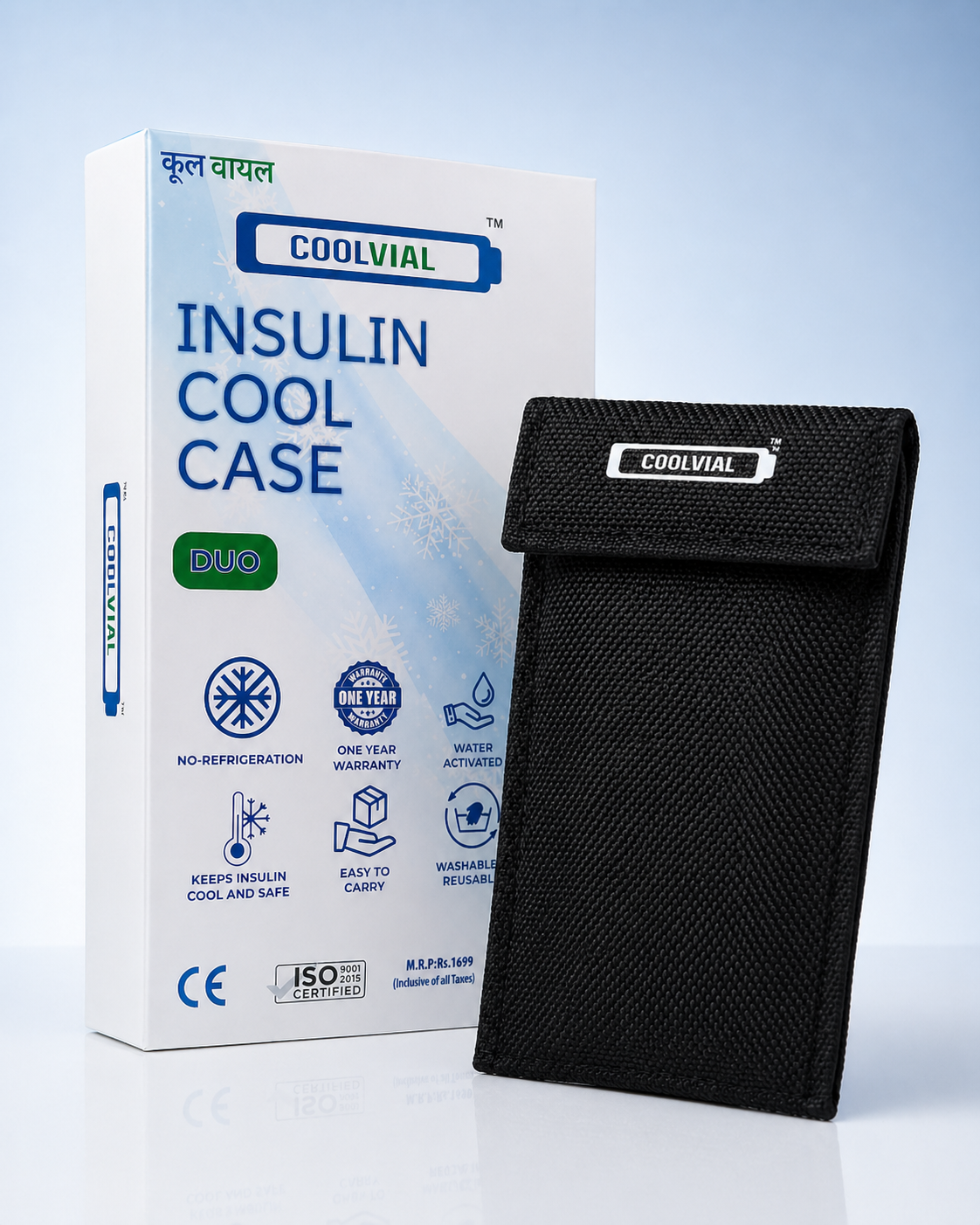
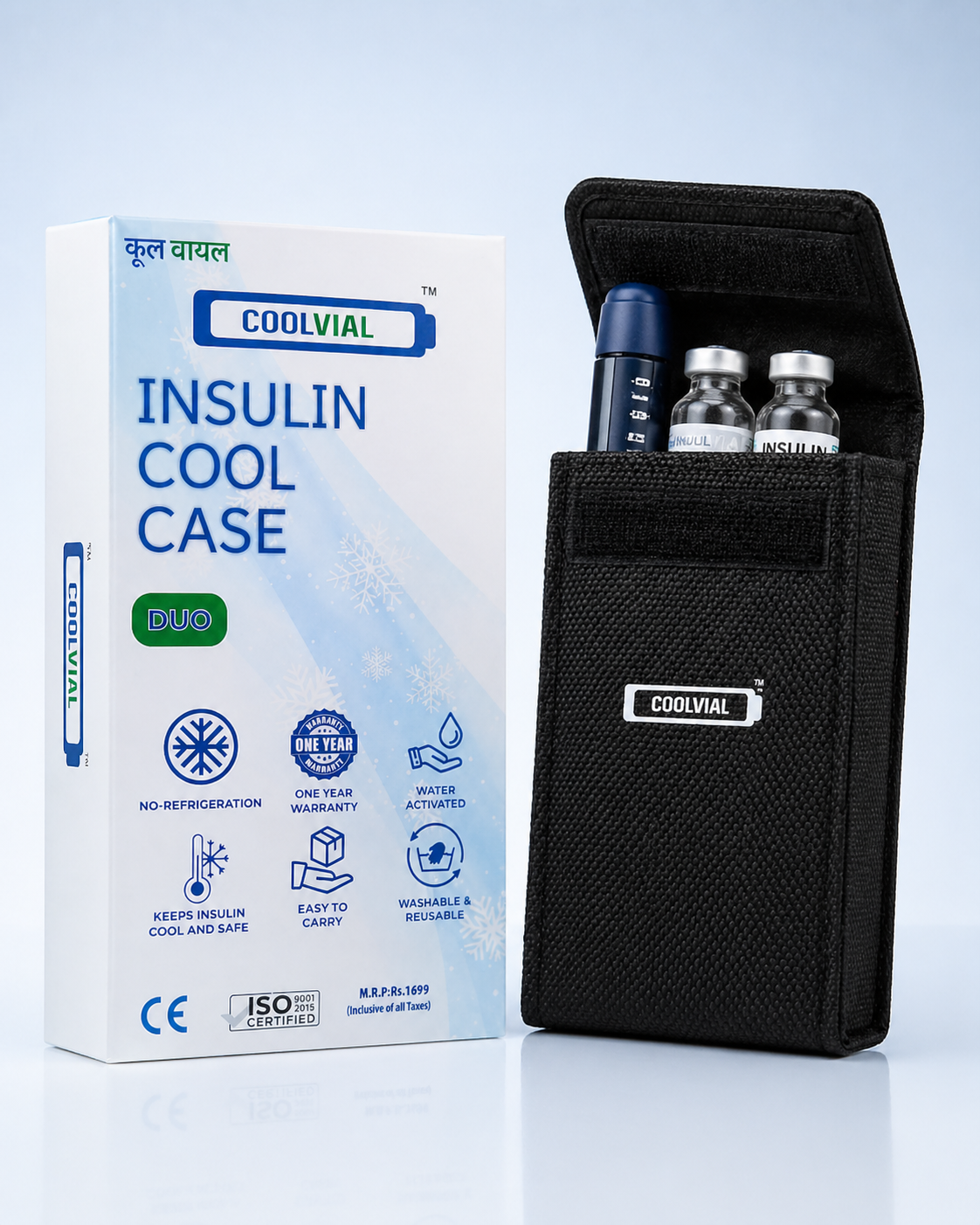
The COOLVIAL Duo is a water-activated evaporative insulin cooling case designed to keep your insulin safe without electricity or refrigeration. It leverages the simple, yet highly effective, principle of evaporative cooling, making it perfect for Rajkot’s hot and sometimes humid environment (average rainfall ~600mm during monsoon, otherwise low).
Why COOLVIAL Duo Stands Out:
- Extended Cooling Performance: It keeps insulin cool and safe between 18-26°C for an impressive 12-16 hours, even when the ambient temperature is as high as 38°C. This is crucial for long train journeys from Rajkot Junction or road trips to Dwarka, where access to refrigeration is non-existent.
- Capacity: The COOLVIAL Duo is thoughtfully designed to hold 2 insulin pens and 1 insulin vial, accommodating the needs of most insulin users.
- No Electricity Needed: Simply immerse the inner pouch in cold water for a few minutes, and it’s activated. This makes it incredibly convenient for travel, eliminating worries about power outlets, batteries, or finding ice.
- CE Certified & ISO 9001:2015: These certifications assure you of its quality, safety, and adherence to international standards.
- Made in India: Proudly manufactured in India, the COOLVIAL Duo understands the specific needs and climatic conditions of Indian users.
- Affordable & Durable: Priced competitively at Rs 1,099 with code COOLHEAL (MRP Rs 1,699), it offers superior value. It also comes with a 1-year warranty, demonstrating our confidence in its durability.
10 Essential Tips for Travelling From Rajkot With Insulin: A Complete Guide
Comparison with Other Cooling Solutions:
| Feature | COOLVIAL Duo | FRIO Cool Case (e.g., Duo Pen Case) | Outer Woods OW-12 (Insulated Pouch) |
|---|---|---|---|
| Cooling Method | Water-activated evaporative | Water-activated evaporative | Gel-pack / Ice-pack (needs freezing) |
| Cooling Duration | 12-16 hours | Up to 45 hours (varies by product) | 12-24 hours (depends on pack size/quality) |
| Electricity Req. | No | No | No (but gel pack needs freezer) |
| Capacity | 2 pens + 1 vial | Varies by model (e.g., 2 pens) | Varies by model (e.g., 1-2 pens) |
| Certifications | CE, ISO 9001:2015 | ISO 9001:2015 (for company) | N/A (for cooling performance) |
| Made in India | Yes | No (UK brand) | Yes |
| Price (approx.) | Rs 1,099 (with COOLHEAL code) | Rs 1,900+ | Rs 999+ |
| Pros | Reliable, no electricity, Indian climate-focused | Long duration, established brand | Affordable, simple insulation |
| Cons | Needs water for activation | Higher price point | Relies on frozen gel packs, less active cooling |
For the price point and its robust performance tailored for Indian conditions, the COOLVIAL Duo presents an excellent balance of features and affordability, making it an ideal choice for anyone regularly travelling from Rajkot with insulin.
8. Frequently Asked Questions (FAQs)
Q: Can I put insulin in checked luggage when flying from Rajkot? A: No, you should never put insulin in checked luggage. The cargo hold of an aircraft is not temperature-controlled and can experience extreme freezing or heating temperatures that will damage your insulin.
Q: Do I need a doctor’s letter to carry insulin at Rajkot Airport (RAJ) or Hirasar (HSR)? A: While not strictly mandatory for domestic flights, a doctor’s letter is highly recommended. It can help avoid questions from CISF personnel about your insulin, syringes, and cooling solutions like gel packs.
Q: How long can insulin stay out of the fridge when travelling? A: Most opened insulin pens or vials can be kept at room temperature (typically below 25-30°C) for up to 28 days. Unopened insulin, however, must be refrigerated between 2°C and 8°C until first use. Always check your specific insulin’s leaflet for precise storage guidelines.
Q: Are train pantry car fridges safe for storing insulin from Rajkot Junction (RJT)? A: Absolutely not. Train pantry car fridges are unreliable, often lack consistent temperature control, and are subject to frequent power fluctuations, making them unsafe for insulin storage. Always use a personal evaporative cooler.
Q: What is the biggest risk for insulin during a road trip from Rajkot? A: The biggest risk is leaving insulin in a parked car. The interior of a car can reach extremely high temperatures (well over 50°C) very quickly, especially in Rajkot’s climate, which will rapidly degrade insulin. Always take your insulin with you, even for short stops.
Q: How does a water-activated evaporative cooler like COOLVIAL Duo work? A: Evaporative coolers contain special crystals that, when immersed in water, absorb it to form a gel. This gel then slowly evaporates, drawing heat away from the insulin inside and maintaining a cool, stable temperature for many hours without electricity.
Q: Can I use Rapido bike-taxis in Rajkot if I’m carrying insulin? A: It is generally advisable to avoid Rapido bike-taxis or auto-rickshaws for transporting insulin, especially during hot hours, as they offer no protection from direct sunlight and high ambient temperatures. If unavoidable, ensure your insulin is in a compact, well-protected cooling case.
Conclusion
Navigating travel with insulin, particularly when travelling from Rajkot with insulin, demands careful planning and reliable solutions. Rajkot’s dynamic environment, from its airports to its roads, presents unique challenges that can impact the efficacy of your life-saving medication. By understanding the specific risks associated with air, train, and road travel, and by taking proactive steps like carrying a doctor’s letter, packing extra supplies, and utilising an effective cooling case, you can ensure your insulin remains safe and potent throughout your journey.
Never underestimate the importance of proper insulin storage. Your health and well-being depend on it. With the right preparation and the trusted protection of solutions like the COOLVIAL Duo, you can explore the rich landscapes of Gujarat and beyond with confidence and peace of mind.
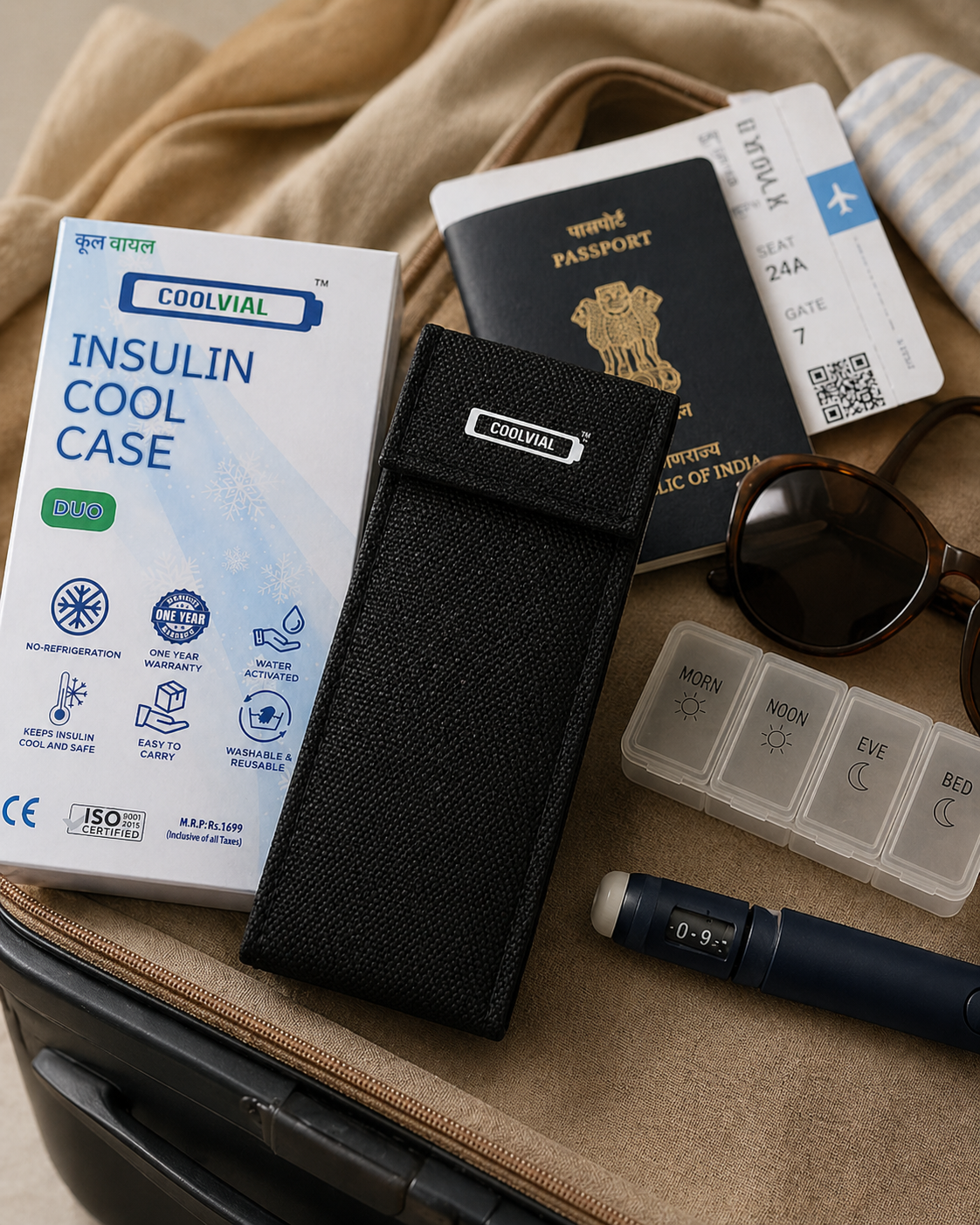
Order your COOLVIAL Duo today at just Rs 1,099 with code COOLHEAL at coolvial.com or via WhatsApp wa.me/918766952300. Embark on your next adventure from Rajkot, worry-free.
Medical Disclaimer
This article is for general information purposes only and does not constitute medical advice. Always consult your endocrinologist or diabetologist before changing insulin storage or dosing practices, or for any health concerns.
How We Researched This
This article was meticulously crafted based on a comprehensive review of current RSSDI (Research Society for the Study of Diabetes in India) guidelines for insulin storage, ICMR-INDIAB (Indian Council of Medical Research - India Diabetes) data on diabetes prevalence, local Rajkot hospital directories (including Sterling Hospital Rajkot (Saurashtra), Synergy Hospital, and NM Virani Wockhardt Hospital), and information gathered from pharmacy networks such as Apollo Pharmacy, Wellness Forever, MedPlus, 1mg, and Generic Aadhaar. Climate data for the Saurashtra region was also referenced to provide accurate temperature context. Specific local travel realities were informed by user queries and ground-level observations in Rajkot.
10 Essential Tips for Travelling From Rajkot With Insulin: A Complete Guide
48+ hours at 2-8°C. No electricity. CE certified. Free delivery across India.
Order on WhatsApp — ₹1,099🛒 Buy Now — ₹1,099